
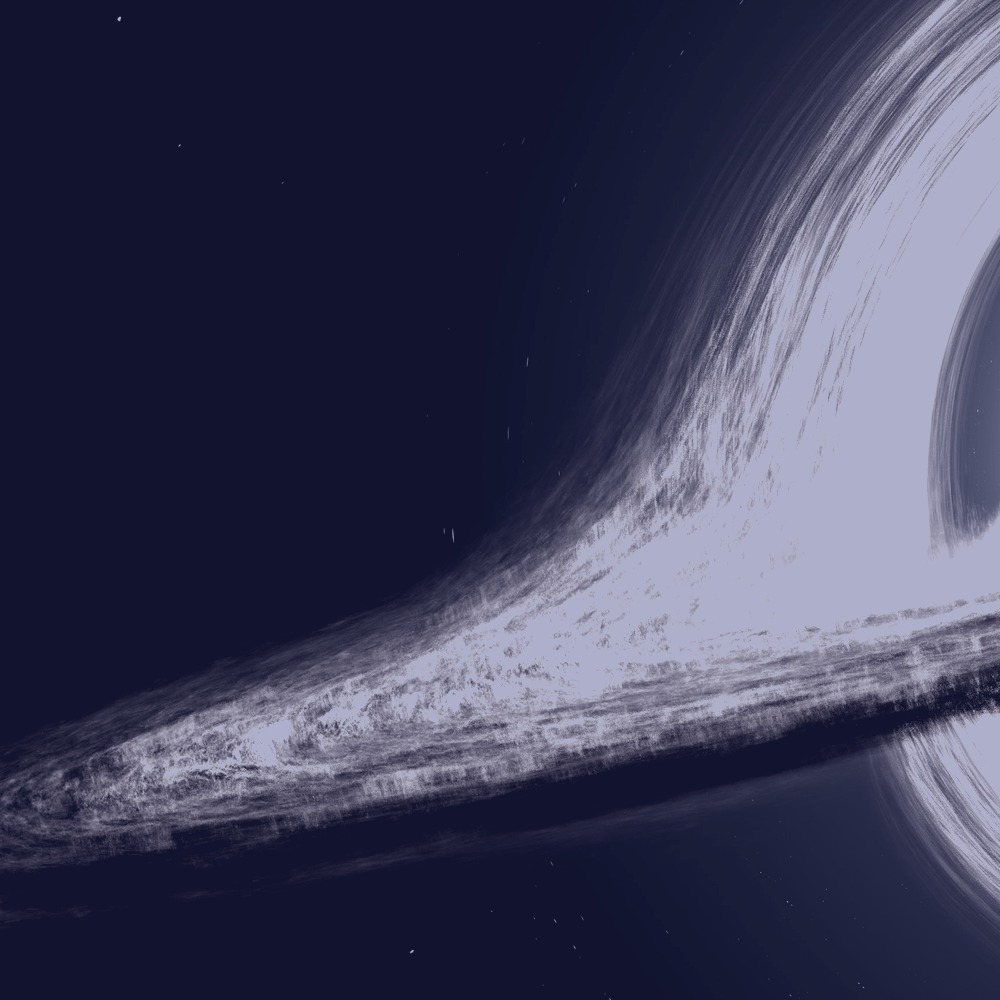
Cover photo: Adis Resic (Pexels) — black hole with accretion disk render
Time Dilation: A One-Way Ticket to the Future
A ten-minute trip to a black hole — and no way to know how many years you'll lose.
About
You're offered a seat on a ship. It will take you to the edge of a black hole and bring you back. For you, ten minutes. The problem isn't the danger — it's that you don't know how much time will have passed, when you return, for the people you love.
To answer, you first have to understand something already happening inside your own body: your head ages a fraction faster than your feet, and in 2010 physicists at NIST measured it across the height of a couple of stair steps. We follow the thread from two travelers cutting through curved spacetime, to the GPS satellites above your head, to a light clock built from two mirrors, to muons passing through your body every minute, to two men who flew around the Earth with atomic clocks on ordinary tickets, and to a scene in "Interstellar" that turns out to be closer to the truth than you'd think.
The trip to the future is real, proven, and already happening around you. The only problem is that it only goes one way.
Sources
- NIST — "NIST Clock Experiment Demonstrates That Your Head is Older Than Your Feet" (2010).
- NIST — "A Powerful Tool for Science: Putting Einstein to the Test" (GPS relativistic corrections).
- Wikipedia — "Shapiro time delay."
- NASA Science — "What Happens When Something Gets Too Close to a Black Hole?"
- NASA Science — "10 Questions You Might Have About Black Holes."
- Hafele, J.C. & Keating, R.E. — "Around-the-World Atomic Clocks: Observed Relativistic Time Gains", Science (1972).
- Particle Data Group — muon mean lifetime and properties.
- Space.com — excerpt from "The Science of Interstellar" (Kip Thorne).
Similar audiobooks
 Science19 minThe Experiment That Erased Reality
The Experiment That Erased Reality
Discover how a simple test with light and matter shattered classical physics and revealed quantum realms.
 History14 minGold: A History of Obsession
Gold: A History of Obsession
Why one metal has driven humans to extremes, again and again, on every continent and in every era.
 Psychology & Growth19 minNicotine: The Molecule That Hacks Your Brain
Nicotine: The Molecule That Hacks Your Brain
How a plant molecule reaches your brain in seconds — and why it's so hard to quit.
 Politics22 minUkraine: The History Behind the War
Ukraine: The History Behind the War
A thousand years of broken promises, language bans, and famine behind today's war.
 Economics & Business18 minBitcoin: The Currency Nobody Controls
Bitcoin: The Currency Nobody Controls
A currency with no bank, no government, and a creator who vanished leaving billions untouched.
 History17 minSeptember 11: The Day That Changed the World
September 11: The Day That Changed the World
The true story of the September 11 terrorist attacks, and twenty years of consequences.
 Ideas & Philosophy21 minHow Artificial Intelligence Is Becoming Our New God
How Artificial Intelligence Is Becoming Our New God
From the Oracle of Delphi to a glowing screen at midnight: why we trust a machine like an authority.
 History22 minRome: The Eternal City
Rome: The Eternal City
From the she-wolf of Romulus to the coins of the Trevi Fountain — twenty-seven centuries of history, layer by layer.


