
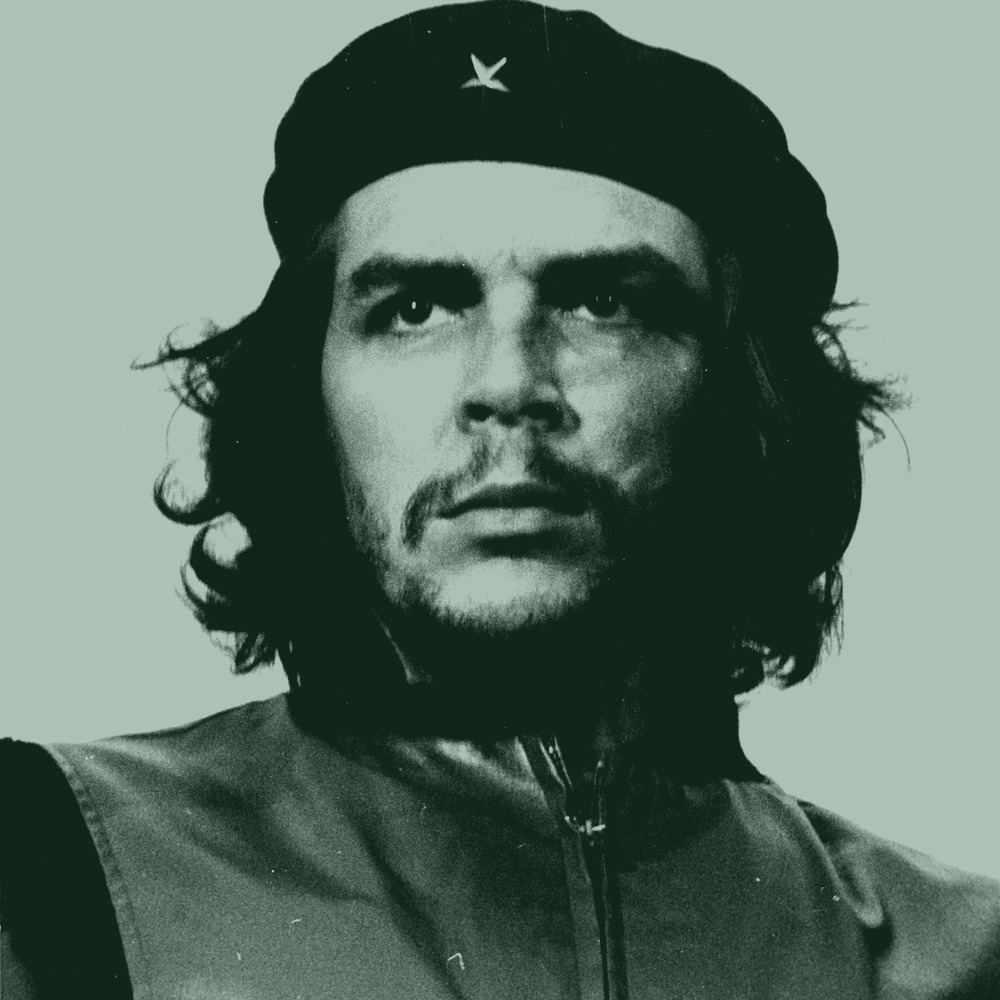
Cover photo: Alberto Korda, "Guerrillero Heroico" (1960) — public domain, Wikimedia Commons
Che Guevara: The Man and the Icon
The doctor who became a guerrilla and a minister — and, in the end, the most reproduced photograph in history.
About
In nineteen fifty-one, a twenty-three-year-old medical student crossed Latin America on a battered motorcycle and saw a poverty that looked far from accidental. Ten years later he was a comandante of a victorious revolution, a bank president, a government minister — and the commander of a fortress where he signed death sentences without full trials.
Ernesto "Che" Guevara voluntarily resigned from every position he held in Cuba to fight first in the Congo, then in Bolivia, where he was captured and executed without trial in nineteen sixty-seven, at the age of thirty-nine — the same fate he had imposed on others eight years earlier. A few years before his death, a photograph that wasn't even published when it was taken turned him into the most reproduced face of the twentieth century.
A story about the incorruptible idealist and the dogmatic executioner who lived in the same man — and about how little of him survives on a printed T-shirt.
Sources
- Wikipedia — "Che Guevara" — https://en.wikipedia.org/wiki/Che_Guevara
- Britannica — "Che Guevara" — https://www.britannica.com/biography/Che-Guevara
- Wikipedia — "Alberto Korda" — https://en.wikipedia.org/wiki/Alberto_Korda
- Wikipedia — "Guerrillero Heroico" — https://en.wikipedia.org/wiki/Guerrillero_Heroico
- Wikipedia — "1954 Guatemalan coup d'état" — https://en.wikipedia.org/wiki/1954_Guatemalan_coup_d%27%C3%A9tat
- Wikipedia — "Bolivian campaign (Che Guevara)" — https://en.wikipedia.org/wiki/Bolivian_campaign
Similar audiobooks
 Politics22 minUkraine: The History Behind the War
Ukraine: The History Behind the War
A thousand years of broken promises, language bans, and famine behind today's war.
 History17 minSeptember 11: The Day That Changed the World
September 11: The Day That Changed the World
The true story of the September 11 terrorist attacks, and twenty years of consequences.
 Economics & Business18 minBitcoin: The Currency Nobody Controls
Bitcoin: The Currency Nobody Controls
A currency with no bank, no government, and a creator who vanished leaving billions untouched.
 History15 minEAM-ELAS: From the Epic of Resistance to the Shadow of Civil War
EAM-ELAS: From the Epic of Resistance to the Shadow of Civil War
The gripping story of Greece's largest WWII resistance movement and the dark price of power.
 History17 minThe Invasion of Cyprus
The Invasion of Cyprus
The coup that was staged in the name of union — and brought partition instead.
 History22 minRome: The Eternal City
Rome: The Eternal City
From the she-wolf of Romulus to the coins of the Trevi Fountain — twenty-seven centuries of history, layer by layer.
 History14 minGold: A History of Obsession
Gold: A History of Obsession
Why one metal has driven humans to extremes, again and again, on every continent and in every era.
 Biographies13 minMikis Theodorakis
Mikis Theodorakis
How a prisoner buried alive became the voice that united two peoples.


